From the Vedas : Sanskrit : ॐ सर्वे भवन्तु सुखिनः | सर्वे शन्तु निरामयाः । सर्वे भद्राणि पश्यन्तु | मा कश्चिद्दुःखभाग्भवेत् । ॐ शान्तिः शान्तिः शान्तिः | English : Om, May All become Happy, May All become free from Illness, May All see what is Auspicious, Let no one Suffer, Om Peace, Peace, Peace.

STAY CONNECTED

SUBSCRIBE BY E-MAIL
Showing posts with label hinduism. Show all posts

Thursday, 9 June 2011

Christianity's Similarities with Hinduism

By Stephen Knapp

You may find it surprising that much of Christianity originated from India. Indeed, over the centuries, numerous historians and sages have pointed out that not only has Hinduism had a predominant influence on Christianity, but that many of the Christian rites could be directly borrowed from Hindu (Vedic) India.


French historian Alain Danielou had noticed as early as 1950 that "a great number of events which surround the birth of Christ - as it is related in the Gospels - strangely reminded us of Buddha's and Krishna's legends." Danielou quotes as examples the structure of the Christian Church, which resembles that of the Buddhist Chaitya; the rigorous asceticism of certain early Christian sects, which reminds one of the asceticism of Jain and Buddhist saints; the veneration of relics, the usage of holy water, which is an Indian practice, and the word "Amen," which comes from the Hindu (Sanskrit) "OM." 


Another historian, Belgium's Konraad Elst, also remarks "that many early Christian saints, such as Hippolytus of Rome, possessed an intimate knowledge of Brahmanism." Elst even quotes the famous Saint Augustine who wrote: "We never cease to look towards India, where many things are proposed to our admiration." 


Unfortunately, remarks American Indianist David Frawley, "from the second century onwards, Christian leaders decided to break away from the Hindu influence and show that Christianity only started with the birth of Christ." Hence, many later saints began branding Brahmins as "heretics," and Saint Gregory set a future trend by publicly destroying the "pagan" idols of the Hindus. 


In fact, Hinduism's pervading influence seems to go much earlier than Christianity. American mathematician, A. Seindenberg, has, for example, shown that the Shulbasutras, the ancient Vedic science of mathematics, constitute the source of mathematics in the antique world of Babylon to Greece: "The arithmetic equations of the Shulbasutras were used in the observation of the triangle by the Babylonians as well as in the edification of Egyptian pyramids, in particular the funeral altar in the form of pyramid known in the Vedic world as smasana-cit." 


In astronomy too, the "Indus" (from the valley of the Indus) have left a universal legacy, determining for instance the dates of solstices, as noted by 18th century French astronomer Jean Sylvain Bailly: "The movement of stars which was calculated by Hindus 4,500 years ago, does not differ even by a minute from the tables which we are using today." And he concludes: "The Hindu systems of astronomy are much more ancient than those of the Egyptians-even the Jews derive from the Hindus their knowledge." 


There is also no doubt that the Greeks heavily borrowed from the "Indus." Danielou notes that the Greek cult of Dionysus, which later became Bacchus with the Romans, is a branch of Shaivism: "Greeks spoke of India as the sacred territory of Dionysus, and even historians of Alexander the Great identified the Indian Shiva with Dionysus and mention the dates and legends of the Puranas." French philosopher and Le Monde journalist Jean-Paul Droit recently wrote in his book, The Forgetfulness of India, that "the Greeks loved so much Indian philosophy that Demetrios Galianos had even translated the Bhagavad-gita." 


Many Western and Christian historians have tried to nullify this India influence on Christians and ancient Greece by saying that it is the West through the Aryan invasion, and later the onslaught of Alexander the Great of India, which influenced Indian astronomy, mathematics, architecture, philosophy-and not vice versa. But new archeological and linguistic discoveries have proved that there never was an Aryan invasion and that there is a continuity from the ancient Vedic civilization to the Saraswati culture. 


The Vedas, for instance, which constitute the soul of present day Hinduism, have not been composed in 1500 B.C., as Max Muller arbitrarily decided, but may go back to 7000 years before Christ, giving Hinduism plenty of time to influence Christianity and older civilizations which preceded Christianity.
Thus, we should be aware of and point out the close links which exist between Christianity and Hinduism (ancient Vedic culture), which bind them into a sacred brotherhood. Conscientious Christian and Western scholars can realize how the world humanity's basic culture is Vedic through proper research.


Great Indian sages, such as Sri Aurobindu and Sri Sri Ravi Shankar, the founder of the Art of Living, have often remarked that the stories recounting how Jesus came to India to be initiated are probably true. Sri Sri Ravi Shankar notes, for instance, that Jesus sometimes wore an orange robe, the Hindu symbol of renunciation of the world, which was not a usual practice in Judaism. "In the same way," he continues, "the worshiping of Virgin Mary in Catholicism is probably borrowed from the Hindu cult of Devi." Bells too, which cannot be found today in Synagogues, the surviving form of Judaism, are used in church-and we all know their importance in Buddhism and Hinduism for thousands of years, even up to the present day. 


There are many other similarities between Hinduism and Christianity, including the use of incense, sacred bread (prasadam), the different altars around churches (which recall the manifold deities in their niches inside Hindu temples), reciting prayers on the rosary (Vedic japamala), the Christian Trinity (the ancient Vedic trinity of Brahma, Vishnu and Shiva as the creator, maintainer and destroyer respectively, as well as Lord Krishna as the Supreme Lord, the all-pervading Brahman as the holy ghost, and Paramatma as the expansion or son of the Lord), Christian processions, and the use of the sign of the cross (anganyasa), and so many others.

Tuesday, 7 June 2011

Who is a Hindu? What is Hinduism

Introduction

If we think of Hinduism in a limited context, we may think of it as a religion and then whoever is born in that religion would be considered a Hindu, i.e. a Hindu by birth or a JanmaHindu. However, in reality Hindu Dharma is an attitude; and it is far more than a religious ideology. This article goes by the definition of Hindu given in the Hindu holy text the Merutantra, which essentially shows, that to be a Hindu is an attitude. 

Definition


In the holy text the Merutantra, the word ‘Hindu’ is defined as 'Hinani Gunani dushyati iti Hindu.' Meaning that which destroys or dushyati the inferior Raja-Tama components or gunas (subtle spiritual components) is a Hindu. Thus, to be a Hindu is to follow a way of life that enhances the spiritually pure Sattva component and Sattva predominant qualities like love, humility, courage, expansiveness, etc. and overcomes the spiritually impure Raja-Tama predominant attitudes like anger, attachment, jealousy, greed, lust, pride etc.

Sattva, Raja and Tama: The three subtle basic components of Sattva, Raja and Tama are the very fabric of creation. Unknown to modern sciences, they permeate through all living and non-living, tangible and intangible things. The vibrations emitted by anything are dependent on its predominant subtle basic component. They also influence the behavior of all things. The proportion of these components in human beings can only be changed by spiritual practice.

Hindu by birth and action   

One can be a Hindu by his actions (karma) or birth (Janma).
Karma Hindu -> is a Hindu by his deeds and qualities or spiritual components
Janma Hindu -> is a Hindu by birth.
Since to be a Hindu is an attitude, a KarmaHindu is a true Hindu. He is Hindu by action and thought, a follower of Dharma and spreads Dharma, which is a sāttvik or spiritually pure way of life. 


How is Hinduism unique from other religions?
 
Hinduism cannot be neatly slotted into any particular belief system. Unlike other religions, Hinduism is a way of life, a Dharma, that is, the law that governs all action. It has its own beliefs, traditions, advanced system of ethics, meaningful rituals, philosophy and theology. The religious tradition of Hinduism is solely responsible for the creation of such original concepts and practices as Yoga, Ayurveda, Vastu, Jyotish, Yajna, Puja, Tantra, Vedanta, Karma, etc. 


How and when did Hinduism originate?
 
Hinduism has its origins in such remote past that it cannot be traced to any one individual. Some scholars believe that Hinduism must have existed even in circa 10000 B.C. and that the earliest of the Hindu scriptures – The Rig Veda – was composed well before 6500 B.C. The word "Hinduism" is not to be found anywhere in the scriptures, and the term "Hindu" was introduced by foreigners who referred to people living across the River Indus or Sindhu, in the north of India, around which the Vedic religion is believed to have originated. 


What are the basic tenets of Hinduism?
 
There is no “one Hinduism”, and so it lacks any unified system of beliefs and ideas. Hinduism is a conglomerate of diverse beliefs and traditions, in which the prominent themes include:
  • Dharma (ethics and duties)
  • Samsara (rebirth)
  • Karma (right action)
  • Moksha (liberation from the cycle of Samsara)
It also believes in truth, honesty, non-violence, celibacy, cleanliness, contentment, prayers, austerity, perseverance, penance, and pious company.

What are the key Hindu scriptures?
 
The basic scriptures of Hinduism, which is collectively referred to as "Shastras", are essentially a collection of spiritual laws discovered by different saints and sages at different points in its long history. The Two types of sacred writings comprise the Hindu scriptures: "Shruti" (heard) and "Smriti" (memorized). They were passed on from generation to generation orally for centuries before they were written down mostly in the Sanskrit language. The major and most popular Hindu texts include the Bhagavad Gita, the Upanishads, and the epics of Ramayana and Mahabharata.
What are the major Hindu deities?
 
Hinduism believes that there is only one supreme Absolute called "Brahman". However, it does not advocate the worship of any one particular deity. The gods and goddesses of Hinduism amount to thousands or even millions, all representing the many aspects of Brahman. Therefore, this faith is characterized by the multiplicity of deities. The most fundamental of Hindu deities is the Trinity of Brahma, Vishnu and Shiva - creator, preserver and destroyer respectively. Hindus also worship spirits, trees, animals and even planets.

Who is a Hindu and how to become one?
 
A Hindu is an individual who accepts and lives by the religious guidance of the Vedic scriptures. While the teachings of the Hindu tradition do not require that you have a religious affiliation to Hinduism in order to receive its inner teachings, it can be very helpful to formally become a Hindu because it provides one a formal connection to the “world's oldest continually existing enlightenment tradition."

Saints on: Who is a Hindu?

Sometimes, people who would like to follow the Hindu way of life or be called Hindu, inquire about ritualistic procedures, such as dikshā to convert into Hindu Dharma. From time to time we also hear about people being accepted into Hindu Dharma after such rituals, which are performed by Hindu Dhaarmik authorities. Here we present some teachings by Hindu Saints on who is a Hindu:

His Holiness Sree Gulabrao Mahārāj on who should be called a Hindu:
  1. "One who accepts the Vēds, Vendaangs, Purāṇs and related sects and one who has been born in a traditionally Hindu family.
  2. One who sincerely accepts the above (the Vēds, Vendaangs, Purāṇs and related sects) is also called a Hindu by initiation (DikshaaHindu).
  3. One who does not accept either of the above, but has been born to Hindu parents is merely Hindu by birth (Janmaartha Hindu or JanmaHindu).
The best definition is if both factors are present (as in point a. above), but if only one of the factors is present (as in points b. and c. above), I consider the definition of a Hindu by initiation to be superior."


His Holiness Kane Mahārāj on the definition of a Hindu:
  1. "One who despises Raja-Tama predominant, inferior attitudes, and the resulting inferior physical, verbal and mental actions,
  2. One who is immersed in a Sattva predominant attitude and hence, one who considers worship of the divine (spiritual practice) as the sole purpose of life and attains God-realization and
  3. One who follows the matchless path (Karmayoga) to guide society (in spiritual practice)
should be called a Hindu. This is an expansive definition of the word Hindu. Thus, Hindu is a spiritually pure (Sattva predominant) attitude. It means to be a seeker (sādhak) of the divine."

Thursday, 2 June 2011

Forefather of Indian Muslims Were Hindus


To commemorate the memory of Shri Chhatrapati Shivaji Maharaj, the mighty and visionary Hindu ruler, who demolished the Islamic domination in India and founded the Hindu Empire in 1674, the Eleventh Hindu Sangathan Divas (Hindu Unity Day) was celebrated with a great fanfare and enthusiasm in New York on July 24 by the representatives of fifty Hindu organizations (including temples). More than 700 Hindus from the different states of India, Nepal, Pakistan, Bangladesh, Sri Lanka, Fiji, Caribbean Islands, mingled together with great joy in the spirit of brotherhood, keeping aside their differences of caste, color and nationality.

The spectacle was seen to be believed. The enthusiastic gathering debunked the fallacious theories advanced by the prophets of doom that Hindus can never be brought together on one single platform. This year’s Hindu Sangathan Divas was dedicated to the memory of Mausiji Smt. Laxmibai Kelker who laid the foundation of Rashtriya Sevika Samiti in Bharat.

In his scathing attack on those whose commitment to the motherland is ambivalent or ad hoc or who feel no kinship to Hindus, Chief Guest at the Eleventh Hindu Sangathan Divas, Dr. Subramanian Swamy, former Union Law Minister of India said that they should acknowledge the Hindu foundation of India, that their forefathers were Hindus, that they did not come from Persia. “India is only for those who swear that Bharat or Hindustan is their matru-bhoomi and karma-bhoomi,” thundred Dr. Swamy.

Hindus are under a state of siege in India and they do not even realize it,” exclaimed Dr. Subramanian Swamy. The forces which want to undermine the Hindu faith and Hindu spirit in India are clandestine and deceptive. It is a matter of great regret that Hindus themselves are being used as pawns in this sinister conspiracy directed by foreigners who have no love for India. Urging audience to visit his website www.indiaright.org, Dr. Swamy said that undiluted unity of Hindus based and fostered on the fundamentals of renaissance is the need of the hour.

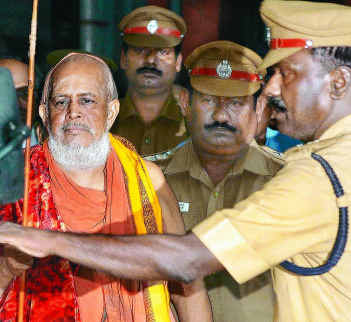
Listing the injustices perpetrated and sacrileges heaped on Hindus and their age-old institutions with impunity, and with the sophistication of constitutional instruments of law, Dr. Subramanian Swamy said that the arrest and imprisonment of 2500 year old Kanchi Mutt Shankaracharya, patronizing of Christian evangelist Benny Hill by Karnataka Chief Minister and Central Government ministers, attack on Ram Temple in Ayodhya by foreign terrorists, taking over the Hindu-temple land by Congress governments in Andhra Pradesh, smack of a deep rooted conspiracy to hold Hindus under siege in Bharat.

We Hindus are the descendants of brave and victorious kings like Chhatrapati Shivaji and the Vijayanagaram Kings. Hence, Hindus should develop a mindset to retaliate in the face of unprovoked attacks. Our retaliation must be massive enough to deter any future attacks. There was a spontaneous uproarious applause of approval from the audience when Dr. Swamy said that if terrorists come from the training camps in Pakistan, those training camps, no matter what the consequences, must be carpet bombed.

Swamy Aksharanand ji, the Keynote Speaker, who holds a Ph.D. degree in Hindu Studies from the University of Madison, Wisconsin (USA) deplored that it was unbecoming on the part of leaders of one billion strong Hindus to look at the United States and complain about the cross border terrorism (from Pakistan) and cry like babies.

He spoke extensively regarding the falsity of the “equality of religions” propagated by none other than Swami Vivekananda and Gandhi not to mention the modern day gurus and saints. The concept that “All religions are one” as propagated by Gandhi incessantly is the most destructive concept that is affecting us all. It is not only silly but dangerous fallacy to propagate the idea that all religions are one. Some of these gurus and sanyasis from India come here at the United Nations and invoke Allah and Jesus Christ. In fact, what are they saying to us Hindus, who are under severe attacks every day by the same forces of Allah and Christ. Hinduism and other religions can’t be equated and called same because “religions” of the world have been born in the environment of hostility. Tracing the origin of Abrahamic religions, Swami Aksharananda said that when Christianity came on the scene, it had to develop an antagonistic philosophy to deal with Judaism. When Islam came on the scene, it had to develop an antagonistic philosophy in order to deal with both Christianity and Judaism. He stressed on the point that Islam and Christianity in their very genesis are hostile and antagonistic creeds.

Three prominent Hindu journalists, Dr. Prakash Swamy, Prem N. Chopra and Brahm Kanchibothla and Dr. Uma Mysorekar, President of Hindu Temple Society of North America, were honored and recognized for their meritorious contributions to the Hindu society in North America. Vijay Nahata, an Indian American businessman, presented certificates of achievements to them.

Dr. D. Bhattacharaya, Prof. at Columbia University, described the tragic condition of Hindus and other minorities in Bangladesh. Dr. Babu Suseelan, Professor in Clinical Psychology and Director of Addiction Research Institute, Pennsylvania, spoke about the “Psychological Warfare Against Hindus.” Dr. Chirag Patel, a scholar at The Vedic Foundation at Austin, Texas spoke about “Reclaiming the Greatness of Hindu Dharma.” Venkat Sarma, President of Kerala Hindus of North America, spoke on “Hindu Unity in the Land of Sankara.” Rajyalaxmi, a disciple of Barfani Baba, spoke about the “Muslim Problem in Nepal.”

Srichand Sidhwani, a senior Sangh karyakarta, vividly explained the differences between “Religion and Dharma,” equating religions to Adharma. Rene Lobo, Community News Director at ITV, urged the audience to get involved in local politics. Swami Jyotirmayananda read an inspiring passage “I am Proud to Call Myself Hindu” from his book “Vivekananda, His Gospel of Man-making.” Dr. Ved Chaudhary gave the information about “Dharma Summit 2005” to be held in month of August in NJ. The program was closely coordinated by Arish Sahani. Ram Dular Singh emceed the program and Kishore Advani proposed the vote of thanks.

Earlier, welcoming the Hindu public and community leaders, Narain Kataria, organizer of the event said that the word “Hindu” had a very powerful and magical spell. The word Hindu had the power to touch the deep nerve in Hindu psyche. The word “Hindu” had the incredible capability to transcend the barriers of caste, creed, color, province or nationality. The word Hindu had the potential to bind one billion Hindus together. India was the only country in the world that was being ruled by the minorities. He, however, did not subscribe to the prevailing notion that Sikhs were the minority in India. “Hindus are the only people in the world who are being tortured, killed and murdered and nobody even takes note of it,” Kataria lamented.

Sunday, 29 May 2011

Are Hindus Too Tolerent For their Own Good ? Will Secularism save Hindus from Islam ?


Hindus are being brain washed by using secularism as a Great principle & philosophy , secularism will eventually destroy Hindus .Today we cannot fight terror or pakistan , simply because we are ruled by secularists .India has already suffered a lot , Hindus have suffered Islamic brutality for generations , do you want to suffer more ?


Most Hindus are unaware of the real History of India , that has been whitewashed by Left Wing Liberals . Liberals are the Ultimate Scumbags , they have no patriotism , no nationalism , they are GADDARS of their own people , that is their biggest strength .

Islam needs conversions , since it needs blood to be sacrificed by its followers , it is a cycle , that enables Islam to grow .


Muslim population is growing exponentially , Wait for the day when muslims become +40% in India, hindus are doomed that day. They breed much faster than Rodents.  <Source : expertvoter >


Islamic Bollywood & Cricket are now Bastion of Islam.
Read Machiavelli’s Quotes of Appeasement :

If he yields it from fear, it is for the purpose of avoiding war, and he will rarely escape from that; for he to whom he has from cowardice conceded the one thing will not be satisfied, but will want to take other things from him, and his arrogance will increase as his esteem for the prince is lessened. – Niccoló Machiavelli, The Discourses. 1517

Foreign Policy :
Given the implacable hatred of its enemies ( muslims ) , India cannot afford to show weakness.

"There is no avoiding war; it can only be postponed to the advantage of others ( Islamic Terrorists ) ."

War on Terrorism :
"Still, if you will not fight for the right when you can easily win without bloodshed; if you will not fight when your victory will be sure and not too costly; you may come to the moment when you will have to fight with all the odds against you and only a small chance of survival."

Buddhism was wiped out of India by jihadists who sacked the temples, defaced the images and either killed the Buddhists who resisted, forced them to convert or forced them to flee.

 
History will tell if Hindus suffer the same fate.

The Humiliation of the Kanchi Acharya

Rajeev Srinivasan on the tremendous threat to Hindus

Here is some advice for the UPA government and the media in India on

how best to destroy Hinduism. Not that they need the advice, they have
done quite well on their own:

· On the holiest night in the Hindu calendar, Diwali, the night when

good triumphs over evil, arrest the most visible, revered, and
respectable Hindu religious leader in the country on murder charges 


· Announce a troop withdrawal from J&K at the same time that yet
another murderous terrorist attack on a CRP camp is going on
http://in.rediff.com/news/2004/nov/11pm.htm 


· Have one of your central cabinet ministers announce at a Christian
fundamentalists' meet that he is 'ashamed to have been born a Hindu' 


· Take over Hindu shrines like the Shirdi Ashram, temples in Uttar
Pradesh; target the Tirupati temple and cause problems there over the
demolition of the 1,000-pillar hall 


· Arrest a Hindu sanyasini because she had raised the Indian flag 


· The media should continue to attack Hinduism while never uttering a
word against the damage being done to it by the State. On the day
after the arrest of the Sankaracharya, instead of shock and disbelief,
the Indian media should be full of teary-eyed hagiographies of Yasser
Arafat, a dubious statesman at best

In contrast, here is what happens with respect to other faiths:

· In Kerala, Muslim League Minister Kunjalikutty, accused of what is
probably statutory rape (sex with a minor girl), refuses to step down.
A mob of Muslims attacks media people just because an interview with
the girl was broadcast 


· In Hyderabad, some low-level maulana is arrested, and a Muslim mob
riots and attacks the police station to try and release him

And people still ask me how Hindus are oppressed in India. If even a

single Muslim or Christian or Marxist is arrested, the cry goes up:
"Islam in danger!", "Secularism in danger!" or something along those
lines. But this doesn't apply to Hinduism, clearly.

How would Catholic Christians like it if on Christmas night the Pope

were arrested for murder? The arrest of the venerable Sri Jayendra
Saraswati, Sankaracharya on Kanchi, on Diwali night, is the equivalent
of that http://in.rediff.com/news/2004/nov/11tn.htm . Yet, I don't see
masses of Hindus out there rioting to get the Sankaracharya released.
This, I personally believe, is a character flaw on the part of Hindus.
They should be out there rioting, then their religion would not be in
danger
all the time. The sentiments of millions of devout Hindus are
being trampled upon because the UPA government knows Hindus will not
react violently.


Meanwhile, back at the ranch, the White House 'celebrated'

Diwali. Indian-Americans, who had contributed significant amounts to
the Bush campaign, were disappointed because neither Bush, his wife,
nor any of his senior staff bothered to attend the function. Former
Ambassador to India Robert Blackwill – a lame duck, as he has resigned
– did attend, and he weasel-worded that Bush would not attend a
country-specific function.

This is nonsense, because Hindus are in at least a hundred countries

around the world: Hinduism is not a country-specific religion. In
reality, in a stinging reminder of the relative importance of Hindus,
Bush did attend, just a few hours later, a Muslim iftar party. Bush is
afraid of Muslims, he is not worried about Hindus.

I actually understand Bush's reasons quite well. As Christian

fundamentalists, he and his pals necessarily despise Hindus. They
despise Muslims too, but they are afraid of Muslims, so they pay at
least lip-service to Islam. Besides, many of his cohorts, oil men,
have some connection to Saudi oil and money. But the Hindus, they can
be discarded like used tissue paper. Money talks, of course. Oil talks
even louder.

Kindly note that 'Bobby' Jindal, the Great Brown Hope, also did not

attend the Diwali function at the White House. So much for the
expectation that Jindal was going to do a lot for India. No, as a
fiery converted Christian, Jindal has no interest in the 'heathen'
religion of his ancestors, or by extension, in India's affairs. Why am
I not in the least bit surprised? Converts are the worst, as they have
to prove their conversion correct.

It has become the role of Hindus to be the under-class, the

water-carriers and wood-cutters for Christians and Muslims. Thus the
Christian fundamentalists will happily take money from rich
Hindu-Americans, but there is no quid pro quo. The Hindu-American
doctors and engineers who give their money are being taken for a ride.

In India, there is circumstantial evidence: whenever I am in Kerala, I

read Malayalam newspapers, and I have noticed a trend, and admittedly
this is only a sample. A number of soldiers from Kerala have been
killed in battle or terrorist attacks, and every single one of them I
can remember has been a Hindu. Not one Muslim or Christian that I have
noticed, over several years. What does this mean? Only Hindus are poor
enough to need to take up dangerous work like in the military, for
lack of better opportunities. So they die, defending the Muslims and
Christians, who get a free ride.

Similarly, when T R Baalu announced at a Christian fundamentalist

meeting (this must have thrilled them no end) that he was ashamed to
have been born Hindu, the UPA worthies did not scold him for being an
obnoxious person. In a truly secular state, no religion should be
insulted by a government official. But I forgot, India is only a
'secular' state, which means it is an anti-Hindu State. See my earlier
column on the perversion of secularism.

Wait, there is more. Instead of pronouncing a death threat to Baalu,

some Hindus proceeded to peacefully excommunicate him. Now the State
swung into motion, and arrested the would-be excommunicators! See
http://www.deccanherald.com/deccanherald/july182004/n6.asp Logically,
if a person is ashamed of being part of a group, doesn't that group
have the right to exclude him? I guess not, if they are Hindus: they
must swallow the insult silently.

But other religions have the right to do so. For instance, when some

Muslims pronounced a fatwa on Salman Rushdie and asked for his head, I
don't remember the State arresting them. Similarly, I suspect that
when Malayalam writer Ponkunnam Varkey was expelled from the Catholic
church, the police did not show up and demand that he be reinstated.
Naturally, I guess, because only Hindus are subject to being
controlled by the State. Others are above the law.

The DMK openly exulted at the arrest of the Sankaracharya. The DMK

have specialized in anti-Hindu polemic partly because the entire
edifice of their belief, of some sui generis 'Dravidian' culture, is
complete hogwash. It was manufactured by a Christian priest, one
Bishop Caldwell, with the intent of divide-and-rule. In reality, Tamil
culture is Indic: Hindu, Buddhist, Jain, just the same as the culture
in other parts of the country.

If you look at the motives for the arrest of the Sankaracharya, the

question arises: who benefits? Clearly, the DMK, they who claim to be
'rationalists' and 'anti-religion' but even their lionized leader EV
Ramaswamy Naicker was too scared to utter a word against Muslim or
Christian practices: which means they are basically an anti-Hindu
entity because they can get away with it.

My immediate suspicion is that this is political payback for a couple

of things: one, what Jayalalitha did to Karunanidhi, two, what
Subramaniam Swamy is suggesting these days.

First, Jayalalitha had Karunanidhi arrested on a holiday, so that

there would no chance to apply for bail; and so now the Sankaracharya
is arrested on a major holiday. Jayalalitha, being a Tamil Brahmin,
would presumably be hurt because the Kanchi Matham is a Tamil Brahmin
stronghold, which the DMK has a special aversion to. Karunanidhi's
statement on November 11th about the prime suspect in the Raman murder
case being at large gives credence to this argument
http://www.sulekha.com/news/nhc.aspx?cid=407194

Second, Subramaniam Swamy has been going around with a fierce campaign

against Sonia Gandhi. For instance, he was scheduled to speak in
Chicago on November 7th on the topic of "Sonia Gandhi: A National
Security Threat to India". What better payback to Swamy than to attack
his power base, the Tamil Brahmins? It is a well-known secret that
Swamy gains much of his support and information from the Tamil Brahmin
bureaucracy at the center.

There is a third possibility: that this is a part of the ongoing

Christian missionary efforts to paint revered Hindu religious leaders
in a bad light. Every Hindu leader is accused of some wrong-doing,
without proof. They trust that by their favorite tactic of 'truth by
repeated assertion' some of it will stick (as they have demonstrated
in the mythology of the arrival of Thomas the Apostle in India, a
fabrication which is now widely believed).

I keep getting mail from some (white Christian?) Australian nut-case

about how he has evidence that the Sai Baba molested children, but the
evidence never materializes. Compare this to the hundreds, if not
thousands, of Catholic priests accused and many formally convicted in
court of large-scale pedophilia across several continents. And there
are reports from the Vatican itself of sexual slavery of, and murders
of, nuns.

Now that Christians are in power in India – just look at the cabal

around Sonia Gandhi , there will be renewed enthusiasm from the conversion mavens of the Joshua Project and the 10/40 Project to target Hindus. This might well be the reason for this egregious attack on the Sankaracharya.

Whatever the reason, the UPA government should have handled this

affair with a little more sensitivity and finesse. There was really no
reason to hound the Sankaracharya, chase him around the countryside,
and arrest him with such theatrics, as though he were going to jump
bail and fly out of the country. There was no reason to humiliate this
very spiritual person. Instead, they could have put the Sankaracharya
under house arrest at the Kanchi Matham if needed. But I guess the
intention was indeed to humiliate.

Why on earth would the Sankaracharya order the murder of an

accountant? That seems to completely defy logic. The Sankaracharyas
live totally spartan lives and have no need for money. Besides, even
assuming somebody in the Kanchi Matham wanted to sweep things under
the carpet, it would have been so much easier to just bribe somebody,
rather than go out and murder someone, especially murdering them in a
temple and desecrating the place.

The sentiments of millions of Hindus do not matter to the Congress,

just as the sentiments of Sikhs didn't when they went on a murderous
rampage in 1984, nor when they appointed alleged gang-leader Jagdish
Tytler as a minister.

And where is the principal 'Hindu nationalist' party who should speak

up?
In complete disarray.

The Congress is once again demonstrating that they are a party only

for Muslims and Christians. The foolish Hindus who voted for them
deserve what they get, I suppose.

Friday, 27 May 2011

The Future of Hinduism


by Jayaram V

Hinduism is the name we have given collectively to a group of religious traditions that originated and developed in the Indian subcontinent for the last 6000 years or so. The most dominant of these traditions are Saivism, Vaishnavisim, Shaktism, Vedism, Tantricism, and several ascetic and folk traditions, which are now part of Hinduism and whose identity is difficult to establish separately. In addition to these, several schools of philosophy became part of Hindu tradition, the most popular of them being Samkhya, Yoga, Nyaya, Vaisheshkia, Mimansa and Vedanta, which are presently designated as the Darshanas or view points. It is a fact that in the west many books and educational programs on world philosophy ignore these six schools of Indian philosophy and focus more on Greek philosophies, which is an unfortunate trend, because by not knowing about them, the western world has been overlooking a vital link in the development of human knowledge and religious thought. This is not because these schools have any demerits compared to the Greek philosophies, but because they are rooted in Hindu religion and to teach them one has to include the basic concepts of Hinduism in the academic curriculum. For many academicians in the western world, doing so is worse than teaching evolution. In a world dominated mostly by Christian institutions and funded by Christians, it would require immense courage on the part of academicians to rewrite their books of philosophy and glorify the so called pagan religions, without incurring the displeasure of the conservative people, who want their children to be brought up only on Christian values.

To suppress all forms of opposition, either by force or by condemnation has been the way of the western eclectic world, since earlier times. Since the earliest times, the Church has rarely been kind to any notion of insubordination or heresy. It happened in the Roman period to Gnostics and others who opposed the distortion of original Christian teachings or deviated from the official version approved by the Roman authority. It happened again in the medieval period to the so called witches and scientific thinkers, who were burnt on the stakes, on the grounds of religious blasphemy; and it has been happening right now, in a more civilized way, to philosophies that are based on religions like Hinduism, Buddhism and Jainism, and scientific research and theories like evolution that seem to challenge the Biblical notions of creation. Of these six schools only one, Yoga, has become popular in the western world, unfortunately, not as an aspect of Hinduism or Buddhism or the means to achieve self-control and self-realization, but as a set of mere physical and mental exercises to enhance one's well being and energies, devoid of its true philosophy, intent and purpose. 


Strengths 


Hinduism is the oldest surviving religion, currently followed by over a billion people in the world, with a universal appeal that is too difficult to ignore. To understand the future of Hinduism, we have to understand its strengths and weaknesses and identify the threats and opportunities to which it is exposed. Such a study would help us understand what forces are at work and how Hinduism can meet various challenges in order to survive and continue. Its chief strengths are:

1. It is a very flexible, assimilative and adaptive religion, with a broader outlook and many divergent traditions. It is not dogmatic, because it is not based on a particular set of teachings, scriptures or a founder. Its flexibility gives it the special ability to adapts itself to the changing times, without losing its vitality, core values or focus. Hinduism acknowledges that the world is unstable, human mind is fickle, our beliefs and circumstances can change, but Truth is permanent and unchangeable, and it is this Truth it encourages its followers to seek by whatever means they consider appropriate.

2. There is no centralized authority in Hinduism. So any one can be a Hindu, without the need for approval from any one. There are no compulsions to observe any code of conduct, as long as one can find their basis in some scripture, school of thought or the teachings of a guru, saint or seer. One can be even an atheist and still a Hindu.

3. It is not opposed to scientific exploration nor the technological progress of mankind as long as such an activity is not an end by itself, but part of our divine centered search for Truth. It has the ability and flexibility to align itself to both science and spiritualism as two different tools of knowledge. 

4. There are many layers within Hinduism. It has something for every one and every strata of society and offers a broad spectrum of solutions to the problems of human life. From the most ignorant to the most knowledgeable, every one can find solace in Hinduism through ever lasting solutions to their existential, spiritual and personal problems. 

5. Hinduism is a peaceful and tolerant religion. Because it is a composite religion, it has no issues with dogmatic religions which are based on the teachings of a founder or prophet. Its broader religious and philosophical base allows it to find parallels within other religions and coexist with them without feeling threatened or the compulsion to establish its superiority. Hindus are perhaps the only people in the world who have never launched an aggression on other nations on religious grounds. And Hinduism is perhaps the only religion in the world that survived over 700 years of Islamic oppression and 400 years of Christian propaganda.


Weaknesses

Because Hinduism has been an organic religion, which evolved in all directions without proper regulation and assimilated divergent traditions, beliefs and practices, it has both the best and the worst elements. It is wrong to believe and accept that everything that is part of Hindu Dharma is inviolable and unquestionable. To do so would tantamount to fanaticism and dogmatism, neither of which have a place in Hinduism. If Hinduism has to survive and continue as a world religion, it is the duty of every Hindu to recognize its weaknesses and address them sincerely so that we can preserve and protect its vitality and ensure its future. Its main weaknesses are:

1. Hinduism is caste based. Castes in Hinduism are part of Vedic tradition, which is but one aspect of Hinduism. There are other traditions in Hinduism, which do not acknowledge castes. The castes might have served their purpose in ancient India. But today it is one of the chief weaknesses of Hinduism. Birth based caste system is responsible for disunity and discontentment within Hindu society and exodus of many people to other religions. It is also a great hindrance in assimilating many people from other parts of the world, who want to be part of Hindu society. 

2. Besides caste, there are many other divisive forces at work within Hindu society, such as region, language, sects, gurus and even color and race. They keep the society divided, weak and vulnerable. This division runs so deep that even those who migrate to other countries or who have been living there for decades, form caste based, region based or language based associations and try to keep their caste and linguistic identities intact. 

2. Hindu dharmashastras or law books have a particular bias against women and their role in family and society. Currently Hindu women are subject to many social and religious disabilities.

3. If absence of a centralized authority enables Hindus to practice their religion with greater freedom, it also make a vast majority of them irreligious, irresponsible and vulnerable to decadent ideas and practices. The most unfortunate part is many are not serious about their religion, have little understanding of traditions or scriptures and hold on to erroneous ideas and beliefs. Justification of violence, vulgarity in films, unbridled materialism, lack of sincerity and personal integrity are some of the dominant features of Hindu society in India today. When children notice inconsistency in the religious attitude and moral behavior of their parents, they would not develop respect or admiration for the religion in which they are born or the morality it upholds. If parents are ignorant of their religion, they cannot make their children religious. They easily take to western ways and ignore their own traditions as empty rituals bereft of merit or distinction.

4. Diversity of Hinduism is both a strength and weakness. It creates a lot of confusion in the minds of people, as to which path to follow, whom to worship and what to practice. We have many scriptures and teachings of countless gurus and traditions and do not know what to study and what to ignore. A vast majority of Hindus therefore practice popular religion because it is easier to do. They go to temples, follow a religious guru or his or her teachings, do some pooja at home, believe in some practices and superstitions, but are hardly well versed in our scriptures, traditions and practices. So there is a great disconnect between what they practice and what they should ideally do.

5. Decay of traditional institutions. While Hinduism does not have a centralized authority to regulate its affairs, over these centuries it survived on the strength of some of its traditional institutions, recognized in Hinduism as the upholders of Dharma. These are the institutions of family, gurus or spiritual teachers and king or the political authority. These institutions are now in grave danger and unless we find some effective remedies, Hinduism will be a thing of the past. Hindu families used to be joint families, in which children had a great opportunity to learn about their religion, religious practices and family occupation from their elders. Through the practice of dharma, parents used to serve as the role models for their children. The Hindu family as a social unit underwent a great transformation in recent times. Joint family system is almost extinct. In the family structure that we have now, parents are no more performing their obligatory duty as the role models of dharma for their children. They are too busy to worry about the religious knowledge  of their children or the values religion can teach them. They believe that it is the responsibility of the education system, which is in itself defective and narrow in its scope and function. Financial solvency not individual salvation is the current mantra of many Hindu parents. Their main concern is how to educate their sons successfully so that they would get a good job and lots of dowry and how to get rid of their daughters as early as possible with as little dowry by finding a suitable match!. No wonder, when they reach these goals, most of them remain neglected by their children and live unhappily. The institution of religious teachers is also on the wane, with so many dubious characters, claiming themselves as enlightened beings, or confining their teachings to particular sampradayas or some mumbo jumbo yoga practices. Regarding the political authority in India, the less said the better. Now a days it is easier in India for a dacoit or a criminal to become a legislative member or even minister rather than a religious teacher or a temple priest or a brave soldier. 

6. Superstition and obscurantism. There are many superstitious and obscurantist practices of Hinduism, which degrade the religion and make it vulnerable to criticism from within and without. 
Many consider "Om" to be attatched with Hinduism! They dont understand that it is the sound of the universe. The syllable Om is composed of the three sounds a-u-m (in Sanskrit, the vowels a and u combine to become o). How can this belong to a particular religion!?

The Threats 

The gravest threat to Hinduism in India today are political, social and religious in nature. The political threats are mainly caused by the parochial and opportunistic politics played by the political parties in India and the so called secularism in which criminals with a track record of police complaints and leftists with atheistic inclinations are welcome, but  religious people with social and political aims are viewed with grave suspicion and dubbed as Nazi. In the lexicon of Indian politics, secularism means not to speak for Hindus as a religious group and keep a distance from them on any national or social issue. Probably this trend will likely continue indefinitely, unless Hindus themselves become a minority and prove useful in the factional politics of exploitative political parties. 

The social threats are mainly in the form of growing western influences and the dilution of religious activities in the day to day life of individuals. Children in schools, and people outside, who are serious about their religious or moral values, are ridiculed by their friends as traditional and orthodox stereotypes, while those who follow western values and life styles, which are themselves considered decadent in the west, are considered hip hop and progressive. 
The religious threats come from the activities of violent religious groups both within and without, religion based political parties and social institutions opposed to Hinduism and the organizations that use money and material for conversion of Hindus into other religions. 

The Solutions

Hinduism can become a dominant and vibrant religion of the world, through the strengthening of its traditional institutions, namely the institutions of family, of gurus or spiritual teachers and of private organizations, filling in the void left by the political authority, supporting a wide range of activities that are aimed at inculcating the values, knowledge, teachings and activities upheld by the religion and its scriptures. We should also aim to develop either a casteless Hindu society or a society that is structured not on birth based castes but profession based ones, which was probably the ideal of the original Vedic people and part of their cosmic vision. This will be possible only when we are willing to teach the Vedas and other scriptures to qualified people from the so called lower castes and appoint them in our temples and religious institutions as priests and religious heads. It is not that this is going to be a new tradition. It has been practiced in Saivism for the last several centuries. It has the approval of the scriptures and many gurus. We need to make it more universal.

Parents

In the absence of traditional family structure and when the education of children is not rooted in religious and moral values, it becomes the sole responsibility of parents and grand parents to become role models for their own children. The best way to do this is through self example, by practicing religion and maintaining integrity in way that would strengthen children's faith in their religion and respect for their parents. If parents are religious and show consistency in their thought and action, children would believe in them and imbibe their religious values. But if parents are irreligious or if children are not convinced of their parents' religious beliefs and moral values, they would develop skepticism and disbelief and become alienated not only from their parents but also from what they believe in and stand for. Lack of moral and religious integrity is a major social issue in Hindu society today, and if parents do not address this problem seriously in their individual ways, they will become victims of their own actions and suffer from the irreligious behavior of their own children, which is what we are already seeing happening in various families. You cannot expect your children to be religious and carryout their obligatory duties as your children, if you do not undertake your own traditional responsibility as a parent and educate your children. Parents should take this matter seriously to save themselves and their children lot of trouble.

Spiritual Teachers

The institution of religious teachers is somewhat vibrant today. Our religious teachers seem to be doing a great service to the cause of Hinduism. Many of them are well known world personalities. They participate in international conferences, travel all over the world, receive honors from governments and world bodies for their meritorious work, set up spiritual centers in various parts of the world and provide spiritual guidance and mentoring to millions of seekers. While this is a positive development for Hinduism,  most of the institutions and movements initiated by the religious gurus, somehow, degenerate into mere sectarian movements over a period of time or lose their direction somewhere, following the demise of the original founder or due to the petty politics of his followers in their struggle for leadership, money, power or position. 

Secondly, most of these teachers preach their own brand of Hinduism, which is like a concoction brewed out of existing Hindu scriptures, and give it a brand identity of their own, just as the way commercial institutions in the west brand their products to distinguish them from similar products of other companies. Some are even hesitant to call their teachings Hindu, in the hope of drawing followers from other religions, and try to come out with a synthetic philosophy that is neither convincing to the followers of Hinduism nor other religions. Thirdly, the gurus are worshipped by their followers as divinities, instead of as spiritual teachers. They do not see God in their gurus and respect them for that, bur rather the physical body of guru only as God. Hinduism has already thousands of divinities. So one wonders why we need more! 

If we want to protect and preserve Hinduism, we need spiritual teachers of different kind, teachers whose sole purpose would be to preserve the core knowledge of Hindu dharma and help capable people achieve self-realization through spiritual practices. In ancient India serious students of spirituality had to take enormous risks to find their way to a spiritual teacher, who often lived in inaccessible areas for a purpose. This is in contrast to most of today's gurus who rarely stay in their ashrams, helping their serious students. They travel far and wide to reach out to people who are less than half serious or who look for gurus for material benefits.  What we need today are gurus who can open the doors of enlightenment for people who are worthy of higher knowledge and who in turn can preserve and continue the tradition of their masters through their own enlightenment. We have to accept and respect gurus for what they are, teachers who can show us the way and connect us with ourselves. In the process of teaching detachment if gurus succeed only in creating a new attachment between themselves and their followers, the whole purpose is defeated. It is like breeding illusion of another kind. We should therefore learn to respect our gurus and look to them for spiritual guidance, provided if they have time and energy to meet you, know about you and help you personally, as a teacher does to his students, not once in a year or two, not when you can manage to push your way through a frenzied mass of people to the front row, not when you are standing or sitting in an unending queue, but regularly, in person, whenever you need guidance or advice. It is better to wait for such a guru, even if takes long, rather than developing some illusory attachment and sense of dependency on a remote guru who is globally active, has a mass following, addresses a crowd, but does not have time for you or does not even know or vaguely knows that you exist and that you are fit enough for self-realization. Till you find one, prepare yourself, study the scriptures, practice religious discipline and fill your heart with a genuine aspiration for the right kind of guru, someone who can truly show you the self that is hidden behind the golden lid and connect you with your source.  The prescription for today's spiritual dilemmas about gurus and their confusing ways is svadhyaya or self-study. When you are conversant with your own religion and its values, you will find a suitable guru with your buddhi (discriminating intellect) and save yourself and your family from problems. Remember the importance of svadhyaya is recommended by none other than Patanjali, the master of yoga himself.

Institutions

Compared to organized religions, Hinduism is at a great disadvantage because it does not have established patrons. Most of the philanthropic support goes to the temples, gurus and the institutions they create and uphold, not to Hinduism as a religion or a body of eternal knowledge. While such a parochial approach may help some sects and aspects of Hinduism, in the absence of political authority who used to be the upholder of dharma in previous times, the fate of Hinduism today is more or less like that of an orphan, seriously in need of commitment from dedicated people and institutions that can address the problems of Hinduism objectively and sincerely, without any hidden agenda, without any allegiance to any particular movement or ideology or ism or guru or even a divinity. This can be possible only if good people come forward and  establish institutions both in India and elsewhere that are not affiliated to any political party or religious group or school of philosophy and which can serve purely as institutions and organizations of Hinduism. We are proud to declare that Hinduwebsite.com falls into this category and serves the mainstream of Santatan Dharma.

The Unfolding Divine Plan

If anytime in the history of the world there is an opportunity for Hinduism to spread out to various parts of the world and establish itself as a truly world religion it is now. This has become possible for two obvious reasons, the growing wealth of Hindus and their immigration to various parts of the world in recent times. Hinduism is not a missionary religion and will never spread to other parts of the world through acts of conversion. Religious teachers may establish various spiritual centers in different parts of the world and spread their own brand of Hinduism. But as it happened in the past, most of these sectarian movements will raise like flashes of individual brilliance and degenerate into smoke of confusion due to leadership or ethical issues. Hinduism will spread to other parts of the world, just the way vedic religion spread in India millenniums before, peacefully, through individual families and their religious activities and contributions.

If Hinduism is going to establish its roots in different countries, it would be mainly through waves of immigrant Indian families and their religious practices. Knowingly or unknowingly, willingly or unwillingly, in their own limited and ignorant ways, these people would spread the awareness of Hinduism in the communities they live and gradually attract the attention of others. The souls who will be born in these countries and who are destined to become Hindus as a part of their spiritual salvation, will be attracted to their gatherings and become receptive to the ideals, beliefs and values of Hinduism. This is how Hinduism will become a beacon of eternal divine wisdom for the generations to come in different nations of the world. This is God's plan to take the Sanatana Dharma (eternal religion) beyond the shores of India, a process that is already in motion, which no force on earth can stop, unless the Divine wills otherwise, and which is the reason why India is shaping itself into an economic giant.

Conclusion

Hinduism is a continuously evolving religion, with a lot of flexibility already built into it. There is a comprehensive scope and opportunity for Hinduism to mould itself according to the demands and aspirations of the modern world. Since Hinduism is not afraid of scientific explorations, nor the technological progress of mankind, it has the ability to align itself with both science and spiritualism in a balanced manner. Because of its emphasis on self exploration of Truth, without any allegiance to any particular dogma or prophet, Hinduism does not have to force the theories of Darwin or Mendel out of school rooms in order to justify itself, nor suffer from the compulsions of suppressing the freedom of human thought on medieval values in order to continue itself. A Hindu has the freedom to superimpose modern knowledge on his ancient theories and reinforce his own beliefs. He has the freedom to criticize certain aspects of  his own religion, but still remain within its boundaries practicing a philosophy of his own that has its basis in its core values. What better example can there be than the fact that  Internet, the world wide web, or the quantum physics all can serve as models to explain the basic concepts of Hinduism such as maya or the illusory nature of our existence or the theory of atoms propounded by the Vaisheshikas some 2500 - 3000 years ago?


Thursday, 26 May 2011

Hindu population set to fall below 80% in Census 2011

Manika Premsingh and R Jagannathan || Courtesy : firstpost 


Hindus have among the lowest overall sex ratios and child sex ratios in the country as per Census 2001. 

Amit Dave/Reuters

Census 2011 is likely to throw up a psychologically important figure on India’s religious demographics. For the first time in over a century, the proportion of the Hindu population in the country will probably fall below the 80 percent mark — in keeping with the long-term trend of a significant divergence between Hindu and Muslim growth rates.
Demographers like Ashish Bose and SC Gulati have varying viewpoints on the subject. While Bose believes that “it is quite likely that the proportion will be below 80% in 2011”, Gulati says that “A secular trend cannot be predicted for religions based on past data”. The latter view is also backed by another Economic & Political Weekly (EPW) research paper “Hindu-Muslim Fertility Differentials”, which says: “It is true that a Hindu-Muslim differential in fertility persists in India’s demographic reality, but it is no more than one child. It is also not too large to swamp India’s Hindu majority in the foreseeable future. Nor is the gap likely to persist for a very long time as we find that the fertility level among Muslims declines with increasing level of education and standards of living. The faster increase in family planning among Muslims supports this conjecture”.

In a country where Hinduism is the majority religion, it is a unique trend that the proportion of Hindus has shown a secular decline since 1961, matched by a corresponding increase in the proportion of Muslims. While religion is a contentious issue to analyse at any point in time, it is equally imperative to analyse trends deeply enough to understand its socio-economic ramifications. 
Firstpost is raising this issue not to pander to any scare-mongering among Hindus, but because it needs to be understood in the right context. As we await the Census 2011 results on religious demographics, we undertook an analysis of this trend and what it means for the future. Our detailed analysis indicates that while the population of Muslims is indeed growing faster than Hindus, this is only partly due to higher birth rates among them; Hindus, on the other had, also carry a responsibility for the trend in the form of lower longevity, as well as widespread prevalence of gender discrimination and higher mortality among children.

Explaining the trend

The proportion of Hindus has in the population shrunk from 83.4 percent in 1961 to 80.5 percent according to the 2001 census. This trend matches with an almost equivalent proportional rise among the Muslims — from 10.7 percent to 13.4 percent from 1961 to 2001 (and for this reason we also restrict our study to a comparative analysis between these two religions). A declining proportion of Hindus means either that the growth of Hindus is declining or that of other communities is rising. Or, as in this case, a combination of both. Decadal growth in the Hindu population has fallen to 19.3% compared with 23.8% in 1961, as per our estimates based on data from the National Minorities Commission and the Census of India 2001. In comparison, the growth in the Muslim population accelerated from 30.6% in 1961 to 34.6% in 2001. (Figures for religious demography in 2011 are yet to be made available).
For a country that has been battling the population problem for decades, while a decline in the proportion of Hindus has been flagged as a source of concern by religious organisations, to others it actually indicates social progression. It is seen as socially progressive since population growth depends on factors like fertility rates and birth rates.  These, in turn, are influenced by social factors like literacy, in general, and female literacy, in particular, awareness about contraception methods, average age of marriage and the proportion of working women. Lower fertility and birth rates then are pointers to the development of societies as such.

The social factors

On some metrics, Hindus do perform better. According to estimates published in an EPW research paper on “District level fertility estimates for Hindus and Muslims”  in 2005, Crude Birth Rates (CBR, as defined by number of births per 1,000 persons) for Muslims are a much higher at 30.8 as compared with the Hindu number of 24.9 and the all-India average of 25.9. This is also mirrored in a higher Muslim Total Fertility Rate (TFR, as defined by the number of children that would be born to a woman if she were to live to the end of her child-bearing years) of 4.1 as compared with 3.1 for Hindus and 3.2 for all India.
It is hard to overlook the fact that trends in birth rates and fertility rates are seen as commensurate with the expected trends for literacy, use of contraception and workforce participation, despite the differences in methodology of estimation and sources.

Hindu women have slightly higher literacy rates than Muslim women at 53.2 percent and 50.1 percent, respectively as per Census 2001, which has been considered as compared with Census 2011 to keep time periods comparable. Moreover, the last National Family Health Survey (NFHS) in 2005-06 found that while 57.8 percent of Hindus were using contraception, the figure was  much lower at 45.7 percent among the Muslims — suggesting, at least in part, a greater awareness about use of family planning among the Hindus.  We also observe a higher proportion for working women among the Hindus — at 27.5 percent, this is higher than even the all-India average of 25.6 percent, with the Jains, Muslims and Sikhs accounting for a lower than average proportion.
However, this is only half the story told.

The other side

True, the Hindu population growth has declined because of some social progression. However, Hindus also show dismal performance when it comes to other crucial social attributes, namely, focus on healthcare and gender bias.  According to a study by the International Institute for Population Sciences, “Inequality in Human Development by Social and Economic Groups in India”, the life expectancy at birth for Hindus in 2005-06 was 65 years while it was higher at 68 years among Muslims. There is, of course, an element of economic prosperity here as well, with the gap between life expectancy for “poor” Hindus and Muslims being wider than that for the “non-poor” in the two communities.  The overall point, however, remains, that at birth a Muslim has a chance of living longer than a Hindu.

This is clearly related to the fact that in childhood itself a higher proportion of Hindus die. Hindus have an infant mortality rate of 58.5, while the same rate among the Muslims is at 52.4, according to the National Family Health Survey (2005-06), where the infant mortality rate is defined as the probability of dying before the first birthday. Similarly, under-5 mortality is at a high of 76 compared with 70 for Muslims. This fact is also echoed in a research paper by the University of Bristol on “Religion and Childhood Death in India”, which says “Muslim children in India face substantially lower mortality risks than Hindu children. This is surprising because one would have expected just the opposite: Muslims have, on average, lower socio-economic status, higher fertility, shorter birth-spacing, and are a minority group in India that may be expected to live in areas that have relatively poor public provision.”

While it remains to be conclusively proved whether Muslims as such provide better healthcare, it has been pointed out that gender bias is one explanation for this trend. According to a 2004 research paper on “Religion and Fertility in India: The role of son preference and daughter aversion” by researchers at University of Ulster and University of Cambridge, “Muslim fertility in India may be higher than Hindu fertility, but we argue that an important, albeit neglected, issue is not that Muslims have more children than Hindus, but that they treat them better on account of significantly lower levels of daughter aversion.”

As per their estimates, male infant mortality rates (where infant mortality rate is defined as the number of infant deaths as a proportion of live births) among Hindus and Muslims are at 4.5 percent and 4.7 percent, respectively, but the difference in female infant mortality rates is much higher, with the rate among Hindus at 6.3 percent and that among Muslims at 4.6 percent, respectively. The numbers are further corroborated by the fact that Hindus have among the lowest overall sex ratios and child sex ratios in the country as per the Census 2001. The overall sex ratio is higher only than the Sikhs at 931, compared with the Muslims’ sex ratio at 936. The child-sex ratio for Hindus is even worse than Muslims at 925 as compared with 950 for Muslims.  In Census 2011, the overall sex ratio has risen from 933 to 940, but the child-sex ratio has fallen from 927 to 914. The religion-wise breakup will be available only later.

Looking Ahead

So what do these trends mean for the future? That’s tough to say. While for now it might be difficult to know for sure how religious demographics will develop over the coming decades, what is clear is that it looks to be less about one religion’s growth versus the other, and more a reflection of serious demographic issues to be addressed by both.
Proportion of various religions in population : Sheet-1
All 100 100 100 100 100
Hindus 83.4 82.7 82.6 82.0 80.5
Muslims 10.7 11.2 11.4 12.1 13.4
Christians 2.4 2.6 2.4 2.3 2.3
Sikhs 1.8 1.9 2.0 1.9 1.9
Buddhists 0.7 0.7 0.7 0.8 0.8
Others 0.7 0.4 0.4 0.4 0.6
ReligionNot stated 0.2 0.0 0.0 0.1 0.1
Source: National Commission on Minorities
Demographics by Religion : Table 2
All religious communities Sex Ratio Sex Ratio 0-6 yrs. Proportion of Population in 0-6 yrs. Literacy Rate Female Literacy Rate
Hindus
931
925
15.6
65.1
53.2
Muslims
936
950
18.7
59.1
50.1
Christians
1009
964
13.5
80.3
76.2
Sikhs
893
786
12.8
69.4
63.1
Buddhists
953
942
14.4
72.7
61.7
Jains
940
870
10.6
94.1
90.6
Other Religions
992
976
18.0
47.0
33.2
Source: National Commission on Minorities


Some Solutions : 
  • Marriage must be within age 25 for female and 30 for male Hindus.
  • At least THREE babies for every able rural couple and TWO babies for able  urban couple.
  • One baby more considering the capable situation in the name of Dharma.
  • Strict negation and punishments for  female foeticides. 
  • Stress upon small business, self entrepreneurship, small village industries, group farming-cultivation for the maintenance of families, not relying upon services in public or private sectors. 
  • Inter caste marriage under broad Hindu basis avoiding blood relations.
  • Accept and Marriage  with the girls of other religions to mitigate the ill effect of Love Jihad.
  • Marriage without dowry and other superstitious prejudices. 
  • Marriage to maintain divine life and the gaining the full strength of the Hindu society.